
No cows, no orchards and with a lot of AI: This is what our food will look like in a decade

Meat and cheese without a cow and cocoa that doesn't grow on a tree: While Israeli agriculture struggles to survive, a new generation of startups is trying to reinvent our food. From laboratories in South Tel Aviv to greenhouses in the Galilee, we went to check what the future of our plate will look like.
Tal Shahaf
17:10, 22.05.26
Look at your plate. It has a piece of meat, maybe an egg, lots of vegetables hopefully, some colorful fruits for dessert, maybe some cubes of hard cheese. That same plate, ten years from now, will probably be very different. It will feature cultivated meat, plant-based eggs, vegetables with added nutritional values, artificially grown and cultivated fruits, and cheese made without cow's milk. And the catch? You won't really feel the difference.
Meanwhile, the state of Israeli agriculture in 2026 is not brilliant. The threats to dairy farmers, vintners, and citrus growers are multiplying. Miraculously, academia is training young scientists hungry to develop new technologies in the AgTech and FoodTech sectors. The billions in cyber don't interest them, and they are the future of Israeli, and perhaps global, agriculture.
According to a report by Start-Up Nation Central and GrowingIL, the agrifood tech community in Israel, more than 750 AgTech and FoodTech companies operated in Israel in 2025, out of which over 150 are active startups, many of them still in early stages.
These companies develop robotics and agricultural equipment (over 30% of investments in the field), clean energy technologies for agriculture like solar irrigation and carbon capture, personalized AI-based nutrition, and many more.
Israeli startups in the agrifood tech sector present a wealth of technologies. Among other things, precision nutrition to prevent chronic diseases, synthetic biology and cellular agriculture, lab-grown meat, engineered microalgae, and alternative proteins. There are also bio-convergence companies that turn agricultural waste into products, as well as agricultural robotics companies for picking, pruning, and thinning fruit trees, and even for autonomous weeding.
So we went out to gather some new food and agriculture technologies and came back excited, and also a bit worried, because it seems this blossoming branch has been wilting slightly in recent years.
Cocoa without the tree
Kokomodo's story sounds absolutely delicious. The startup aims to produce 100% real cocoa for use in the food industry, including the chocolate industry. The company's product is based on cellular agriculture and allows for a stable supply of raw materials unaffected by climate crises or political fluctuations in traditional growing areas.
Tal Govrin, CEO of Kokomodo, explains the economic and environmental background that led to the company's establishment: "The cocoa market is one of the markets with the highest growth in terms of raw materials. It is a product with very high demand and prices that have risen drastically in recent years. We are bringing a sustainable solution to the global cocoa supply chain, which is experiencing a very deep crisis."
Kokomodo's technology is interesting: "We call it 'cocoa without a tree' - growing cocoa without growing the trees. That's the point of cellular agriculture, as our product is 100% real cocoa," emphasizes Govrin.
"We essentially take tasty cocoa from real cocoa beans, and grow the cells under controlled conditions, in a process that makes growing in nature's orchards redundant. This can be done in a controlled and continuous manner all year round."
Does it remind you of cultivated meat? "It reminds you of cultivated meat, but simpler. In cultivated meat, ultimately you need to create a three-dimensional model, like a steak. Here we start with a collection of cells in a liquid inside a bioreactor, and we don't need to create a complex structure for them. Our technologies allow growing cocoa anywhere in the world, in any climate environment and throughout the entire year."
Milk without a cow
There are many companies producing milk alternatives, but NewMoo does it differently. The company, founded in 2021 by Aviad Meisels, Dafna Miller, Hod Yanover, and Dr. Yulia Fridman, is based on groundbreaking research by Prof. Asaf Aharoni from the Weizmann Institute. It develops a sort of plant-based milk designed to serve as a raw material for the global cheese industry.
Dafna Miller, the company's CEO, brings over 20 years of managerial and marketing experience from leading food companies, including Tnuva. She explains: "Ultimately, we come from the food and dairy industry, and we truly understand how the food industry works behind the scenes."
While most milk alternative companies turned to precision fermentation technology, NewMoo chose the path of Plant Molecular Farming. The company managed to make the soy plant express caseins, which are the building blocks of cheese, responsible for its texture, melting, and elasticity. Thus, NewMoo produces a liquid rich in milk proteins that replaces cow's milk in cheese production processes.
What is the difference between this and soy milk? "There is no connection whatsoever to the regular soy milk we have on shelves. In this case, the soy is our host; it's a kind of natural bioreactor. We extract the milk proteins from the seeds in a unique process."
"We achieved two breakthroughs: for the first time, we successfully expressed the four caseins in plants exactly as they appear in cow's milk, and now we have also developed the ability to scale up quantities and produce milk proteins at a competitive price compared to cow proteins. These two breakthroughs will allow us to provide cow-identical milk proteins, at a competitive price, just without the cow."
The smallest vegetable in the world
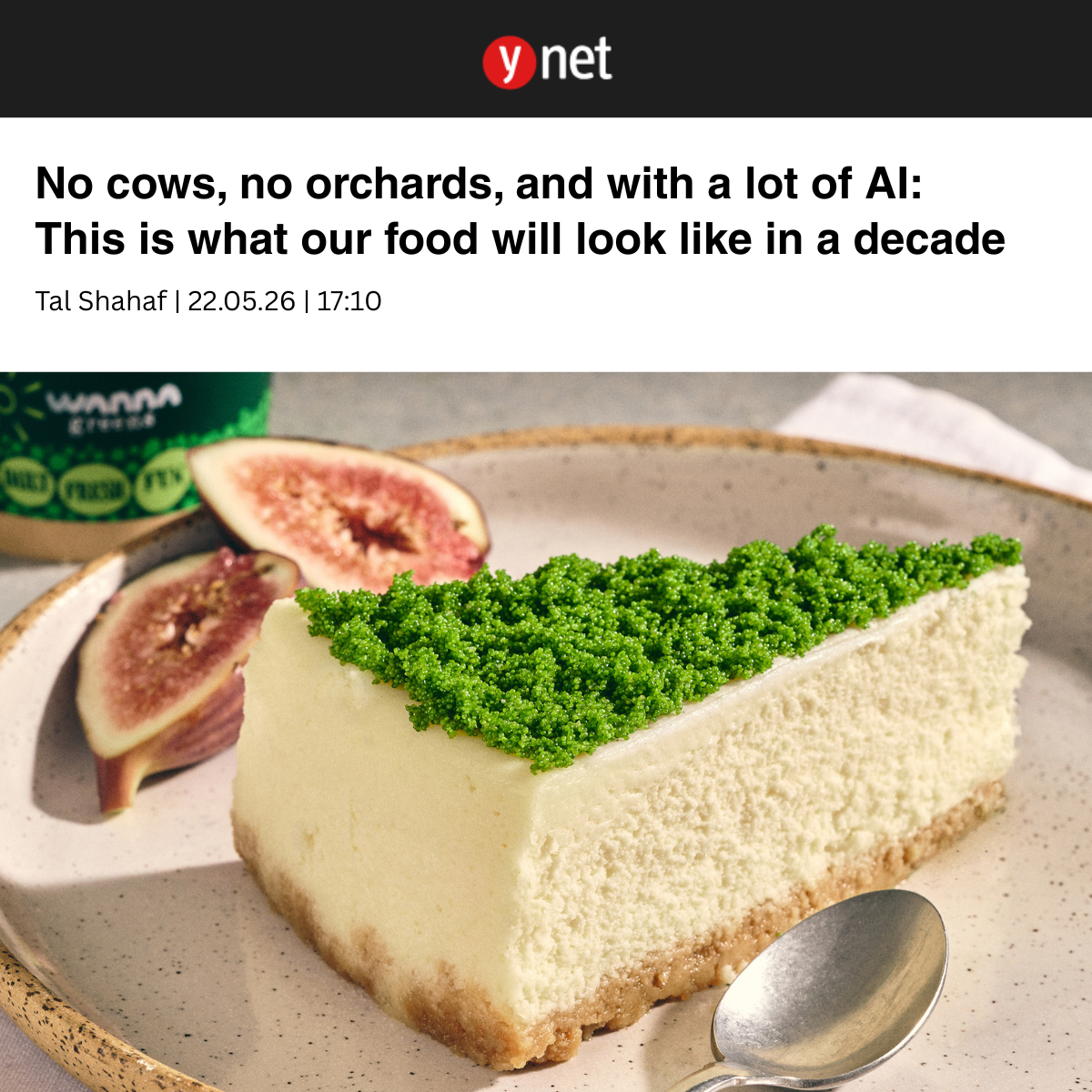
In an industrial and commercial building in South Tel Aviv, GreenOnyx is developing the agricultural infrastructure of the next generation and growing the smallest vegetable in the world - Wolffia, or by its commercial name, Wanna greens. Behind this small box lies years of in-depth research.
"The agriculture of the future shouldn't replace nature, but listen to it, understand it, and protect it," says Dr. Tsipi Shoham, co-founder and CEO of the company. The technology developed by the company, called QFarming, is an agricultural infrastructure based on small, modular growing cells managed completely autonomously.
Unlike companies trying to alter plant genetics, the focus here is on optimal and dynamic management of the growing environment. At the heart of the system operates an advanced sensor array that continuously collects data.
Dr. Shoham explains the connection to AI: "Artificial intelligence needs one thing to be truly smart - Big Data. In our system, a massive amount of data is collected within a closed system where all growing conditions can be controlled. The data is analyzed in a closed loop of monitoring, learning, predicting, and dynamic feedback. The AI doesn't just track the plant - it learns to identify its precise needs at any given moment."
"GreenTalk", as the communication between the computer and plants is called, allows translating the plants' needs into immediate actions in the feeding and lighting system. "In a broader sense, this is a return to the ancient idea of a local, independent, and protected farm, but in a modern, technological version, allowing the growth of fresh and healthy food in the heart of big cities, close to the consumer's plate," says Dr. Shoham.
The fertilizer of the future
The AI revolution hasn't skipped traditional corporate giants either. ICL (formerly Israel Chemicals) has been manufacturing agricultural products and fertilizers for decades, but in recent years it's been undergoing a digital and biological revolution. In 2025, ICL acquired the startup "Lavie Bio" and integrated its employees into the company.
Dr. Michael (Miki) Ionescu, currently head of the biological algorithms team at ICL, says: "We are working on developing future fertilizers, things that incorporate not only traditional minerals and nutrients, but advanced biological materials originating from bacteria and nature."
ICL's technology is based on an AI platform that acts as a biological search engine. The company holds a massive library of hundreds of thousands of bacteria collected from nature. Since humanity lacks the time or resources to test every bacterium in a real field trial, artificial intelligence can predict and map which bacteria can boost specific traits of the plant without altering its genome.
"We can influence plant traits, like naturally increasing sugar percentage in grapes and tomatoes to create tastier, sweeter fruit, or increasing the protein percentage in soybeans," explains Dr. Ionescu.
The team, comprising programmers and bioinformaticians, uses AI to learn from the biological data and design the optimal growth form of the plant. Ionescu notes that the company is in advanced testing stages and is advancing the launch of its first product in the next two years, which will be based on a unique seed coating for field crops.
The FoodTech hype has cooled down
Despite the abundance of impressive technologies and promising companies, one cannot ignore the severe turbulence the sector is going through. Until a few years ago, the FoodTech field was considered the next big promise of Israeli high-tech - a national growth engine meant to replicate the phenomenal success of the cyber industry.
Today, we hear about fewer new companies in the field, fewer glamorous capital raises, and many companies that planned to break into the market and lead the revolution were forced to halt and delay schedules. Some have closed down.
Take cultivated meat, for example. Until recently, the local ecosystem was buzzing with activity. Many companies promised cultivated steaks, cultivated minced meat for burgers, cultivated chicken, pork, and even seafood.
Just about two years ago, the entire industry was excited by the first cultivated eel meat served at a festive chef's dinner. Today, such events have almost vanished from the landscape. Publicly traded companies experienced painful share crashes, and the initial enthusiasm surrounding the cultivated kitchen has cooled significantly.
The sharp decline in investments and scaling back of operations characterized the entire sector globally, but in Israel, the crisis was much deeper and sharper. The local industry took a severe blow following the political storm of recent years, and especially following the difficult war that broke out on October 7.
Many of the most promising FoodTech companies operated in the Kiryat Shmona area, designated and defined as the "official FoodTech capital of Israel." Ofakim was marked as the Israeli AgTech capital, in the heart of an agricultural region that accounts for about 65% of the country's field crops. However, the physical evacuation, prolonged fighting, and economic slowdown led to the shelving of many development plans and a halt in momentum.
Despite the decline, the sector refuses to give up and offers a sober perspective, distinguishing between the bubble of financial expectations and the real, ongoing need for food technologies. Avichai Nissenbaum, co-founder and managing partner at lool Ventures, says: "Like in any industry, we see waves."
"We at lool have been around for over 10 years, and we see an average of 700 to 1,000 companies a year across all fields. And we see the waves. Every wave has a counter-wave. There are over-expectations and over-enthusiasm, and then somewhere there's a pause, from which begins the building of the real companies that will win the market. We are somewhere around there."
So, are we past the hype? "We were in the hype, now we are in the buildup, and many insights have been formed along the way. At first, there was tremendous enthusiasm, for instance from the whole issue of bioreactors, fermentations, and cultivated meat, which brought very nice laboratory results."
"But then the big question arose: where will the growth come from? Where is the capacity to produce at commercial scales? The market came and said, 'Wait, I have something here that I can't take to mass production, and if I can't take it there – maybe this isn't the way, and maybe other solutions are needed'."
Nissenbaum emphasizes that the problem isn't on the demand side, but in the technological and economic ability to produce industrial solutions: "The reality is that the demand for these products is massive. We are currently looking, for example, at another company in the field that deals with alternative fats - there is a massive demand for fat as a substitute for butter and margarine."
"The need is enormous, and from the marketing side too, food manufacturers are looking for healthier and more unique products. So there is no doubt that this field exists and is growing, but on the other hand, there is also no doubt that it is currently suffering from a 'financial climate change'."
Dror Bin, the outgoing CEO of the Innovation Authority, also shares this optimism: "Despite the volatility experienced by the global FoodTech sector in recent years and the reduction of investments in it, Israel continues to be one of the global hubs of FoodTech innovation, with an emphasis on Deep-Tech of alternative proteins and advanced biological manufacturing."
According to Bin, government support in the field has remained continuous and even intensified to bridge the financial "valley of death": Since 2018, the Innovation Authority has invested about NIS 325 million in alternative protein companies, with a consistent increase in annual support volumes reaching a peak of over NIS 81 million.
This trend continues, and in the last operational year, about NIS 90 million was invested in the FoodTech sector by the Authority, with over half of this amount directed straight to alternative protein and deep-tech companies.
"This focus on deep-tech and real, long-term solutions is our anchor, and I am confident that in the near future we will see a gradual recovery and renewed growth in the volume of investments in the sector," Bin concludes.